Ukiyo-e does not feel old in the way people expect old art to feel.
It does not sit there politely, waiting to be respected. It cuts in. A wave rears up. Rain slants across a bridge. A bird grips a reed in falling snow. A figure stands under too much sky. The image is still, but nothing about it feels inert.
That is the first thing to understand about ukiyo-e art. It was a Japanese woodblock print tradition of the Edo period — but it does not survive because it came first, or because museums told us to admire it. It survives because the pictures are built with unusual nerve. They know how much to show. They know what to leave out. They know how to make a fixed scene feel as though it is one breath away from changing.
That is what keeps ukiyo-e modern. Not prophecy. Not nostalgia. Control.
What Ukiyo-e Is, and Where It Came From
Ukiyo-e was a mass-circulated Japanese woodblock print tradition of the Edo period, known for turning actors, courtesans, landscapes, folklore, birds, and everyday life into highly composed images people could buy, display, and live with.
The term is usually translated as “pictures of the floating world.” That can make the work sound airy and decorative. Sometimes it was. More often, it was sharper than that.
Ukiyo-e emerged in a culture shaped by theatre, fashion, travel, entertainment, and urban life. That history matters because it places the form closer to later print culture than many people expect. Ukiyo-e was art, yes — but it was also circulation. The image had to travel, so it had to be strong.
Its subject matter was broad. Actors appeared in heightened poses. Courtesans were arranged with extraordinary elegance. Landscapes opened into wind, road, mountain, and distance. Birds, flowers, reeds, rain, and snow were treated with the same seriousness as people. The subject changed. The visual intelligence did not.
Ukiyo-e does not just depict the world. It edits it.
For a wider view of how Japanese art shaped the visual traditions that followed, see How Japanese Art Shaped Modern Visual Culture.
How the Process Shaped the Form
The process was collaborative. One person designed the image. Another carved the blocks. Another printed the sheet. A publisher oversaw production and sale.
That sounds practical, even mechanical — but it is one reason Japanese woodblock prints look the way they do.
The form rewarded decisiveness. A clear outline survives carving. A clean shape survives printing. Flat colour holds its place. Large forms read quickly. The image cannot afford vagueness, so it learns precision instead.
Reproduction did not cheapen ukiyo-e. It forced discipline on it. The best ukiyo-e prints do not look overworked. They look resolved.
What Defines the Look of Ukiyo-e
Strong line. Flat colour. Selective cropping. Asymmetry. Space.
Those are the usual answers, and they become more interesting the moment you stop listing them and start watching them work.
Ukiyo-e does not fill the frame just because it can. It lets things remain open. Sky stays sky. Water stays water. Air stays air. A branch can arrive from the edge and be enough. A figure can sit low in the composition and the whole image tilts emotionally around that choice.
It crops instead of explaining. It suggests instead of flooding the eye. It trusts placement.
Nature is part of the same logic. Rain is not there to decorate a road. Snow is not there to make the scene pretty. Wind, water, mist, distance, blossom, reeds — they alter the emotional temperature of the image. They do work.

Katsushika Hokusai: Force Under Control
Hokusai is what happens when force meets discipline.
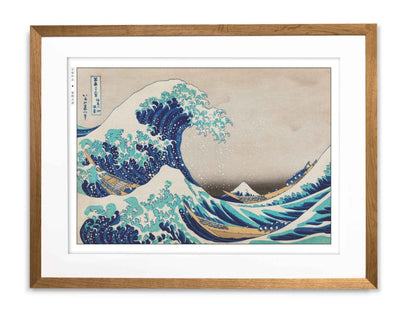
The Great Wave off Kanagawa is famous because it deserves to be. Not because it is iconic, but because it is exact. The curve of the wave is enormous, but it does not sprawl. The foam claws forward. The boats beneath it are tiny enough to make the danger feel human. Fuji stays small and steady in the distance, which somehow makes the whole scene feel more violent, not less.
The print is dramatic, but it never loses its structure. Hokusai can make an image feel vast without letting it become loose.
The same principle runs through Thirty-Six Views of Mount Fuji. Roads open. Slopes angle. Water shifts. Bridges cut across space. The pictures feel active because they are organised so hard. Hokusai does not give you energy by piling things up. He gives it by deciding exactly where everything goes.
That is why he still feels contemporary. The compositions still have edge.
Browse the Hokusai collection for prints that show this discipline in a room.

Ohara Koson: Quiet as Precision
Koson works at the other end of the scale, but the discipline is the same.
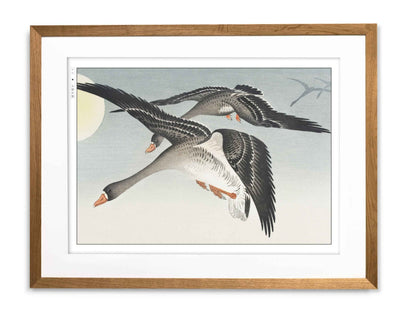
He does not need a giant wave. He does not need spectacle at all. A bird on a branch. Snow gathering. Reeds by water. In Kingfisher and Irises, almost nothing has been pushed too far — and that is exactly why it stays with you.
The angle of the bird matters. The space around it matters. The branch matters. The stillness matters. Remove any of it and the image loses its hold. Add anything and it loses its precision.
Koson’s prints are quiet, but they are not soft in any empty sense. They are exact. He proves that ukiyo-e is not only alive when it surges. It can be just as alive when it barely moves at all.
Hokusai compresses energy. Koson refines attention. Both are working from the same understanding: the image gains strength by not exceeding what it needs.
Browse the Ohara Koson collection for prints that bring that stillness into a room.


How Ukiyo-e Makes Still Images Feel Alive
Ukiyo-e does not usually capture the event itself. It captures the moment just before the event settles.
The wave has not broken yet. The rain has only just changed the road. The bird has not taken flight. The branch has not snapped. The figure has not moved. But the scene is already carrying consequence.
That is why the stillness feels charged.
Ukiyo-e understands that movement becomes stronger when it is withheld. Show everything and the image spends itself too quickly. Stop at the right point and the eye keeps going for you.
Hokusai uses that principle through scale and direction. Koson uses it through pause and atmosphere. Utagawa Hiroshige uses it through weather — his Ohashi Bridge in Sudden Shower does not illustrate rain falling on a bridge. The rain is not added on top of the scene. The rain is the scene. The diagonal lines of falling water turn the whole image into a kind of pressure. The world becomes feeling.
Omission is not emptiness here. It is tension.
What Ukiyo-e Passed to Manga and Anime
The connection to manga and anime is real, but it is easy to talk about it badly.
The lazy version says ukiyo-e came first and then manga and anime borrowed from it. That is not wrong exactly. It is just thin.
The stronger version is compositional. Ukiyo-e helped establish a way of making images work. It trusted the crop. It trusted negative space. It trusted weather, environment, and scale to carry emotion rather than forcing everything into the figure.
Manga develops that logic on the page. A body in white space can feel exposed before the dialogue does anything. A close-up can hold a mood long enough to become uncomfortable. A page gains strength by pausing. For more on how that plays out, see Is Manga Art? Why Panels Are Being Framed and The Evolution of Manga Art Styles.
Anime takes the same instincts into colour and motion. The strongest anime images still depend on placement, emphasis, atmosphere, and restraint. They work because the frame knows where to concentrate the feeling — not because everything is happening. For more on how anime uses those inherited instincts, see Inside Anime’s Visual Identity and How Anime Backgrounds Create Atmosphere.
The line from ukiyo-e to manga and anime is deeper than visual resemblance. What persists is a respect for controlled image-making. More is not always more. Arrangement is meaning. Omission is part of the picture.
Why Ukiyo-e Still Works on the Wall
Stand a Hokusai print in a room and it does not ask for context. It does not wait for you to recall its history or recognise its cultural significance. The wave still rears. The foam still claws. The boats are still small enough to make the scale feel dangerous. The image is doing its work before you have decided anything about it.
A Koson print does something different but equally immediate. The bird holds its position. The branch holds its angle. The space around it holds its silence. The room gets quieter.
The prints still hold because they were built to hold — through restraint, exact placement, and a precise understanding of where the image should end.
That is the real source of ukiyo-e’s influence. It did not become lasting by saying more. It became lasting by understanding how much force a picture can keep when it says less.
The Eastern Archivals Archive
Japanese art prints, manga artwork, and anime wall art — printed on archival matte paper.
Shop the Archive