A road after rain. Empty, reflective, the light sitting differently on the wet surface than it does on dry ground. Nobody has walked through it yet. Nothing has happened.
And yet the frame already has a feeling.
That quality — the way anime backgrounds carry emotional weight before the story arrives, and keep holding it after the moment has passed — is what separates a great background from a setting. A setting tells you where you are. A background tells you how the world is holding the scene.
The tools are simple enough. Scale, light, weather, space. But what they are carrying is not simple at all.
When a vast sky opens above a single figure, the world has already said something about exposure and scale that no dialogue could improve on. When a forest feels dense and old and indifferent, the story has already been shaped before anyone enters it. When rain falls on empty pavement, the scene inherits a mood — something reflective, something isolated, something that was already there waiting.
Anime backgrounds are not passive. They carry emotional conditions. A feeling that begins in a moment — loneliness, tension, stillness, wonder — does not leave when the scene moves on. It settles into the environment. The world holds it.
That is also why these images survive so well outside the episode. Remove the motion. Remove the dialogue. Remove everything except the frame.
The feeling is still there.
What a Background Actually Carries
Most visual storytelling uses environment as context. The world shows you where the story is happening.
Anime often goes further. The world shows you how the story feels.
Before a character speaks, the frame has already tilted. A wide sky makes a figure feel small and exposed. A dim corridor with one hard light source makes the same character feel cornered. An empty road after rain does not just set a scene — it carries a mood that the scene then inhabits.
This is not atmosphere in the decorative sense. It is emotion distributed across the environment rather than concentrated inside a character.
A character’s face shows what they feel in that moment. A background shows what the world is holding — and the world holds it longer.
For a wider look at how environment carries feeling across Japanese art, see The Role of Nature in Japanese Art. For how this logic operates across anime as a whole, see Inside Anime’s Visual Identity.
The Tools: Scale, Light, Weather, Space
Anime backgrounds are built from a small set of elements. What matters is how they are used.
Scale
Scale is the fastest way to establish emotional pressure without stating it.
A figure placed against a vast sky has nowhere to hide. The world is larger than the person inside it, and that imbalance does immediate emotional work. Distance does not need to be explained. Exposure does not need a caption. The proportion alone carries it.
Conversely, a character pressed into a tight frame, surrounded by architecture or shadow, communicates constraint before a word is spoken.
Light
Light sets the emotional temperature of a scene.
In anime, light is never accidental — it is chosen. Soft evening light can make a frame feel reflective or melancholy. Harsh overhead light can make it feel clinical or empty. Strong lateral contrast can make a moment feel dangerous before the plot has confirmed it.
What makes this powerful is that light can shift emotional register between frames, before dialogue, before action. The scene changes temperature and the viewer feels it before understanding why.
Weather
Weather makes the world active.
Rain turns roads reflective and stretches distance outward. Wind unsettles a frame. Mist withholds clarity. These are not effects applied to a scene — they are emotional conditions embedded in the environment.
A rain-soaked street is already carrying something. The scene that takes place inside it inherits that weight.
Emptiness
Some of the strongest anime backgrounds work through refusal rather than abundance.
An empty frame can feel calm, meditative, or brutal depending on what it leaves exposed. Anime often trusts space to carry pressure rather than filling it. A figure left alone in emptiness does not need dialogue to communicate isolation. The space around them says it first.
For the lineage behind that instinct, see How Japanese Art Shaped Modern Visual Culture.
How Hokusai and Hiroshige Built the Foundation
Anime does not invent this relationship between environment and emotion. It inherits it.
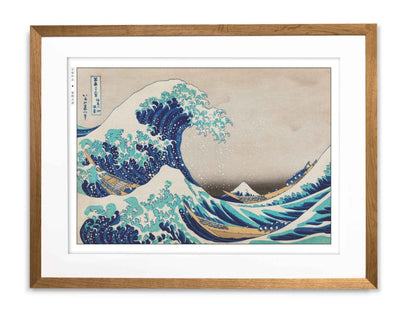
Katsushika Hokusai understood that a wave could carry force before it broke. The famous curl of The Great Wave off Kanagawa is not just impressive — it is pressurised. The water has weight and inevitability. The boats beneath it are not just small. They are subject to something that will not negotiate.
Utagawa Hiroshige took a different approach. His rain falls in long diagonal lines across bridges and roads, creating rhythm and distance at the same time. His snow-covered landscapes hold silence so completely that the image feels cold. Weather in Hiroshige is never decoration. It is the emotional state of the world.
Anime continues both instincts — the force of Hokusai, the quiet of Hiroshige — now in colour and motion. The medium changes. The principle does not: let the world carry the feeling, and the feeling will outlast the moment.
Explore the Hokusai collection and Ohara Koson collection for prints that show how Japanese art has long built emotion into environment.

Studio Ghibli: Worlds That Never Go Neutral
Ghibli backgrounds look gentle. They are never passive.
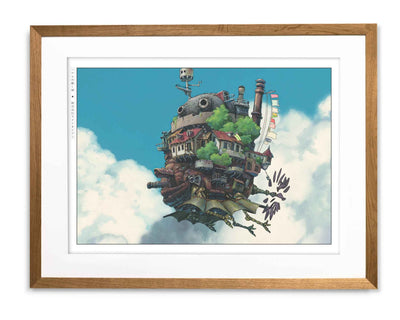
In Howl’s Moving Castle, the landscape does something specific. Rolling hills and broad skies create a sense of ease — openness, natural order, the world continuing as it always has. The castle moves through that world like something that does not belong. The contrast carries a feeling the film never needs to state directly: that Howl is displaced, restless, not yet at rest. The landscape holds that truth even when the camera is on something else.
Princess Mononoke inverts the approach. Its forests are dense, shadowed, and old enough to feel autonomous. Light filters through the canopy but the space rarely clears. The world feels like a force with its own interests — not hostile exactly, but indifferent to human resolution. Characters move through it, but they do not own it.
What links both is the same principle. The world never goes neutral. It keeps carrying weight even as the scene moves on.
That persistence is why Ghibli imagery works on a wall. Remove the motion, and the background is still doing what it was built to do — holding a feeling in visual form. Browse the Studio Ghibli collection for prints that carry that environmental weight into a room.

Eiichiro Oda: Environments as Emotional Architecture
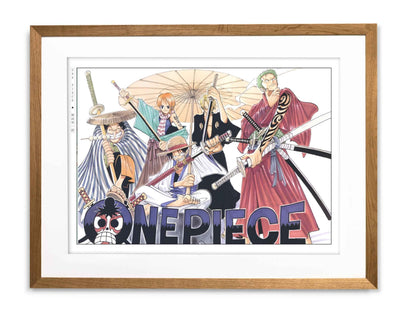
Oda uses background differently from Ghibli but with the same deliberateness. In One Piece, each major setting is built to hold a specific emotional register, and that register shapes how every scene inside it is experienced.
Wano is enclosed. Tiered rooftops step up toward mountain borders. Streets are tight and watched. Even the sky feels bounded. The visual architecture creates pressure and containment — a world where the hierarchy is structural, visible in the layout of the land itself. Before the story of occupation and resistance begins, the setting has already established that this is a place where freedom costs something.
Alabasta works through exposure instead. Sand stretches toward flat horizons. The sun is high and the shadows are hard. There is no shelter and no ambiguity — the landscape is unforgiving and it does not conceal its terms. A character standing in Alabasta is standing in the open, and the world makes sure they know it.
Skypiea removes gravity from the equation. Cloud seas and floating islands create a world where the ground itself is uncertain. The openness is vast but the footing is unreliable. The setting carries a feeling of wonder laced with instability — beautiful and slightly unreal, a place you cannot fully trust.
Three different environments. Three different emotional architectures. In each case, the background is not illustrating the story — it is building the conditions that the story has to live inside. Browse the One Piece collection for prints that bring those environments off the page.

Why These Images Hold on a Wall
A background-led image asks something different of a viewer than a character-led one.
A character image often relies on recognition — you know who this is, you remember what happened here, the image carries meaning because you carry the context. That is a valid kind of power. But it is contingent. It depends on something outside the frame.
A strong background image is not contingent. It carries its emotional condition independently. The feeling is held in the visual structure — in the scale, the light, the weather, the space — and it keeps offering that feeling regardless of whether the viewer knows the series.
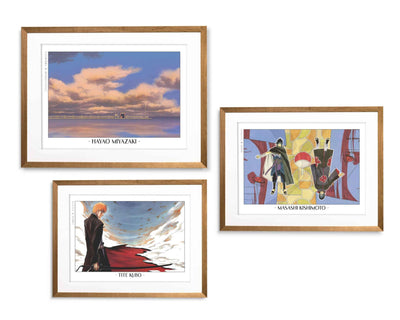
A Ghibli landscape can soften a room without disappearing into it. A One Piece environment can fill a space with a particular kind of energy — openness, or pressure, or something unstable and alive — without resolving into noise. The image keeps offering something because the feeling is still there.
That is a better basis for choosing wall art than recognition alone. Not which scene you loved, but what kind of feeling the image carries — and whether it can keep carrying it once the episode is over.
For more on living with anime artwork, see Anime as Art: From Screen to Wall. For how to display it, see How to Design an Anime Gallery Wall. For the framing decisions that let these images land properly, see Choosing Frames for Manga Artwork.
Framing Held Emotion
There is a temptation, when choosing anime wall art, to go straight for the moment you remember.
The battle. The revelation. The character at the height of their arc.
Those are the moments that moved you. But they are also the moments that rely most heavily on context — on everything that came before them, on the emotional accumulation of the series, on memory doing the work the image cannot do alone.
A background that held emotion during those moments is a different proposition. It does not depend on memory. It carries the feeling directly, in the space and light and scale of the image itself.
The character may be the reason you entered the moment. The background is what stays with you after it ends.
That is what you are framing. Not scenery. Held emotion.
The Eastern Archivals Archive
Japanese art prints, manga artwork, and anime wall art — printed on archival matte paper.
Shop the Archive