Manga and anime did not appear out of nowhere.
Long before modern panels, fight scenes, and painted skies, Japanese artists were already doing something distinctive with the image itself. They knew how to create force with a single line, tension with empty space, and feeling through weather, scale, and silence.
That is part of why Japanese art still feels so modern. Ukiyo-e woodblock prints, manga pages, and anime frames may belong to different eras, but they often share the same instincts. Each knows how to frame a moment, how to make a scene breathe, and how to leave something unsaid without losing power.
Japanese art shaped modern visual culture by building an approach that later carried into manga and anime: bold composition, expressive line, charged empty space, and storytelling driven as much by image as by words. Ukiyo-e helped establish that approach, manga pushed it into sequential black-and-white storytelling, and anime expanded it through colour, motion, and atmosphere.
Seen that way, Japanese art is not just a historical category sitting behind glass. It is part of a much longer story about how pictures move people — one that lives in old prints, in manga panels, in anime worlds, and in the way people still choose to frame and live with those works now.
The Foundations of Japanese Visual Storytelling
Japanese art often says more by showing less.
That sounds simple, but it changes everything. A wide stretch of sky can make a figure feel lonely. Rain can darken the mood before anything dramatic happens. A mountain, a wave, a tree branch, or an empty room can do emotional work that another tradition might hand to dialogue or gesture.
What matters is not only the subject. It is the pressure around it.
In many Japanese works, weather, landscape, and architecture are never just there to fill the scene. Wind creates movement before a body does. Mist softens certainty. A room can feel still without feeling dead. Nature is not backdrop. It is part of the feeling itself.
These instincts carry later into manga and anime with remarkable ease. Silence matters. Framing matters. What is left out matters. For a deeper look at the relationship between environment and meaning, see The Role of Nature in Japanese Art.
Ukiyo-e and the Language of Japanese Illustration
If you want to see where a lot of modern Japanese imagery begins, start here.
Ukiyo-e, the woodblock print tradition of the Edo period, is often translated as “pictures of the floating world.” It gave shape to actors, courtesans, folklore, landscapes, travel, and ordinary life. But what matters most is not just what it showed. It is how those scenes were built.
Strong outlines. Flat planes of colour. Cropped views. Bold, controlled shapes. A sense that the image knows exactly where your eye should go. Nothing feels accidental.
That clarity still feels familiar. You can see echoes of it in manga panels and anime frames, even when the subject matter changes completely. Ukiyo-e had graphic confidence — it could be elegant, forceful, decorative, or sharp, but it rarely felt uncertain.
It also circulated widely. These were not images made only for elite rooms. They moved through everyday life. People bought them, lived with them, remembered them. That puts ukiyo-e closer to later print and image culture than it might first appear. For a fuller historical overview, see Ukiyo-e: Origins and Influence.
Katsushika Hokusai
Hokusai is the easiest proof that old work does not have to feel old.
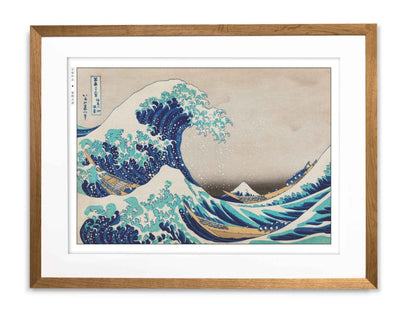
The Great Wave off Kanagawa is famous, but fame is not what gives it force. The image still lands because the construction is so exact. The wave feels heavy before it breaks. Fuji remains calm in the distance. The boats are small enough to make the force around them feel dangerous, but present enough that the danger feels human. Dramatic, yet nothing about it feels overworked.
That is Hokusai’s gift. He knew how to build pressure without clutter, how to make movement feel inevitable, how far simplicity could go before it stopped carrying weight. Explore more in the Hokusai collection.

The Evolution of Woodblock Prints
Woodblock printing did not stay still. It widened.
Different subjects, different moods, different levels of refinement — but one thing remained constant: it made pictures travel. That matters because it helped create a world where strong visual work could belong to daily life rather than only to private collections or elite spaces.
Reproduction, in this case, did not flatten meaning. It spread style.
Manga and anime grow through different technologies and industries, but they inherit something important from print culture: the idea that images can be shared widely and still retain force. People return to them. Collect them. Live with them. See The Evolution of Manga Art Styles.


How Japanese Art Influenced Manga
Manga did not reject older Japanese art. It sped it up.
It took cropping, contrast, rhythm, and restraint, then pushed them into panels and sequence. The result was not just a storytelling format. It was a new way of controlling time on the page.
The best pages do not simply tell you what happened. They make you feel the pause before it, the drag of a silence, the force of a gesture, the shock of a cut from detail to blankness. That is why manga works as art even when people try to reduce it to plot delivery.
And manga understands one of the oldest rules in Japanese art: omission has power. A white background can hit harder than a crowded one. A pause between panels can stretch a moment until it becomes unbearable. Restraint is not absence. It is pressure held in place. For more on black and white as an artistic tool, see The Power of Black and White in Manga.
Cinematic Panel Storytelling
A good manga page tells you where to look. A great one tells you when to stop.
That is where the cinematic quality really lies — not in spectacle alone, but in timing. A close-up can trap you inside a feeling. A wide panel can suddenly make a character feel tiny. Repetition can slow time until it almost sticks. Heavy black can create tension before the story has openly named it.
Manga trusts the eye. It trusts silence. It trusts the reader to do some of the work. That is also why certain panels feel so natural on the wall. They do not need the whole chapter behind them to hold weight. They already feel complete. For display ideas, see Designing a Manga Gallery Wall.
Artists Who Redefined Manga
Not every manga artist works this way. That is part of the point.
Takehiko Inoue, for example, can make a page feel almost suspended. In Vagabond, the linework has weight without becoming heavy. Faces hold emotion without being overplayed. Landscapes breathe. When violence breaks through, it feels stronger because the page has allowed stillness to exist first. He understands pacing at the level of mark-making.
Other artists push in the opposite direction: sharper silhouettes, harder contrast, more graphic impact. That range is one reason manga remains so visually rich as a form. It can be reflective, jagged, raw, elegant, or explosive without losing its sense of control. Browse the Vagabond collection.

How Japanese Art Influenced Anime
Then everything starts to move.
What matters in still work — line, framing, weather, negative space — carries forward, but now it shifts in time. Light changes. Wind passes through grass. Sound deepens the feeling of a room. Colour changes the temperature of a scene in seconds.
That is why anime can feel so immersive when it is done well. It does not only show a world. It lets you sit inside one.
A train carriage at dusk. A street after rain. Evening light on a wall. These moments can carry as much force as a battle or a confession. They stay with people because they are felt as much as seen. This is not separate from earlier Japanese art. It feels more like the same sensitivity opened out into motion. For more, see Anime as Art: From Screen to Wall and How Anime Backgrounds Create Atmosphere.
Bleach and Bold Visual Identity
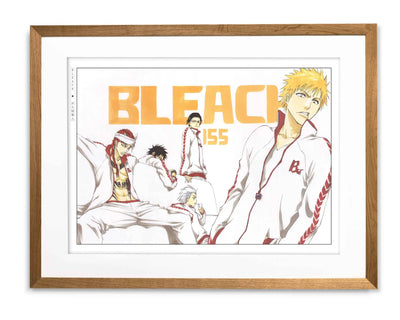
Not all anime works through softness. Bleach does the opposite. It cuts hard. Black against white. Long coats. Sharp poses. A figure that lands in the frame and owns it immediately. That graphic clarity is a huge part of why the series stays visually memorable. Tite Kubo knows how to make silhouette do real work — how to strip a figure down until posture, contrast, and shape carry the charge. Browse the Bleach collection.

Studio Ghibli and Atmospheric Worldbuilding
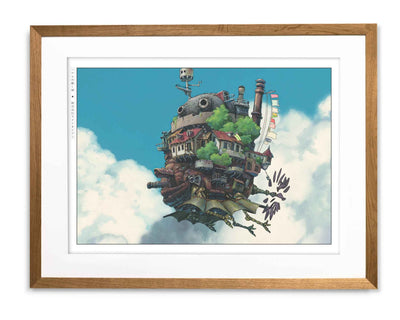
Ghibli works differently. It does not grab by the collar. It draws you in more slowly. A field moving in the wind. Water reflecting light. A bathhouse at dusk. A room crowded with old objects that feel as though they remember the people who touched them. In films like Spirited Away and Howl’s Moving Castle, setting carries part of the emotional weight. The world is not neutral. It is alive, and not in a loud way.
Ghibli feels especially close to older Japanese ways of seeing: quiet matters, weather matters, beauty is never just decoration. It carries mood, memory, and sometimes unease with it. That is also why Ghibli imagery works so naturally as wall art — it can soften a room without disappearing inside it. Browse the Studio Ghibli collection.


From Historical Art Forms to Contemporary Wall Art
The path from woodblock prints to manga pages to anime frames is not just an art-historical line. It also says something about how people live with art now.
Some pieces calm a room. Others sharpen it. Some create stillness. Others create charge. A Hokusai print can feel steady and forceful. A Vagabond panel can bring gravity. A Bleach artwork can add edge. A Studio Ghibli scene can bring warmth without slipping into sweetness. They do not all do the same job. That is exactly why they work.
What links them is intention. Each knows how to hold space and shape mood — and that is why Japanese wall art can feel different from more disposable décor. You are not just filling a wall. You are choosing something with structure, rhythm, and force behind it. For styling ideas, see Designing a Japanese-Inspired Interior.
Japanese art, manga, and anime — three pillars of the Eastern Archivals archive.
The Eastern Archivals Archive
Japanese art prints, manga artwork, and anime wall art — printed on archival matte paper.
Shop the ArchiveCollecting Japanese Artwork Today
To collect Japanese artwork now is to step into a long conversation.
The mediums change. The materials change. The audience changes. Yet certain instincts remain easy to recognise: clarity, control, restraint, atmosphere, sudden force. That is part of what makes Japanese art feel so distinctive across centuries.
A Hokusai print, a Vagabond panel, a Bleach artwork, and a Studio Ghibli scene may come from very different places, but they do not feel random beside each other. They belong to different moments in the same broad story of how a picture can hold tension, beauty, and feeling at once.
Eastern Archivals brings these together as a curatorial space rather than just a shop — Japanese art prints, manga artwork, and anime wall art are not random categories gathered under one roof. They speak to each other. Part of the pleasure is recognising what you love. The deeper pleasure is seeing the thread between it all.