Ukiyo-e, manga, and anime are not three separate traditions. They are one conversation, carried across centuries, about how a picture can hold and then release emotional force.
The connection lives in how the image works. Long before anime used colour and motion to shape feeling, ukiyo-e was already doing it in still form — building tension through cropping, weather, distance, and empty space. Manga sits between the two, taking that held pressure and giving it rhythm across the page. Anime opens it further, into colour, movement, light, and sound.
The same instinct travels through all three. Each medium handles it differently, and each one carries the next.
For the broader story of how these traditions connect, see How Japanese Art Shaped Modern Visual Culture.
What Ukiyo-e Is, and Why It Still Matters
Ukiyo-e was a Japanese woodblock print tradition that flourished during the Edo period, roughly 1603 to 1868. The phrase translates as “pictures of the floating world” — but that makes the work sound softer than it is. These were widely circulated prints that people bought, displayed, and lived with. Their subjects ranged from actors and courtesans to landscapes, folklore, birds, and the turning of the seasons.
Ukiyo-e was never really about the subject. It was about what the image did with the subject.
Strong outlines hold forms in place. Flat planes of colour keep the scene direct. Cropping makes the world feel larger than the frame. Empty space is not absence — it is distance, breath, or pressure. These choices do not simply organise a scene. They control how it lands.
For a fuller historical overview, see Ukiyo-e: Origins and Influence.
How Ukiyo-e Builds Tension
The power of ukiyo-e often lies in what has not happened yet.
A wave curls before it crashes. Rain falls before we know what it will change. A figure stands still, but the space around them is already alive with direction and weight. Ukiyo-e can feel full of motion while remaining completely still — and that suspension is where most of its force lives.
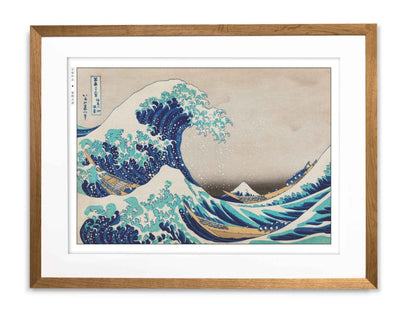
Hokusai makes this unmistakable. The Great Wave off Kanagawa holds you in the moment before impact. The wave feels heavy before it breaks. Mount Fuji stays calm in the distance. The boats are small enough to make the danger feel real, but present enough that it still feels human. Nothing in the frame has moved. Everything in the frame is about to. Explore the Hokusai collection.
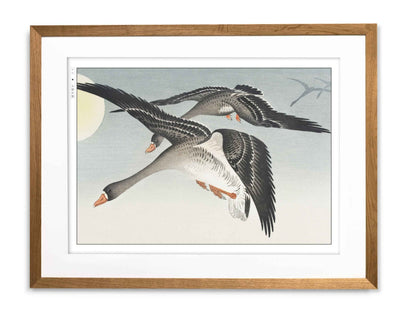
The bird-and-flower prints of Ohara Koson show the quieter end of the same instinct. Heron in Snow, Kingfisher and Irises, the long series of birds observed against seasonal stillness — a season turning almost without announcement. A bird on a branch. Snow settling into reeds. The world pausing just long enough to be felt.
Emotion does not need to be declared. It can be carried by weather, distance, and the arrangement of forms inside a frame. See the Ohara Koson collection.


How Ukiyo-e Shaped Manga
Manga takes that held pressure and gives it rhythm.
It translates ukiyo-e’s deepest instincts into sequence. Cropping becomes panel framing. Empty space becomes pause. A gesture gains force because of what surrounds it. A white background can hit harder than a detailed one, because it leaves nowhere for the moment to go.
A strong panel can do what a strong print does: hold tension inside an image. But manga can stretch that tension across several beats. A close-up traps you inside a thought. A wide shot makes a figure feel small against the world around them. The sequence controls not just what you see, but when you feel it.
Takehiko Inoue shows this with particular clarity in Vagabond. A single figure in open space. A landscape given room to breathe. Silence extended across a page until it accumulates weight. The force comes not from complexity but from restraint — from knowing exactly when to stop. Many Vagabond panels already feel complete before they leave the page, which is why they survive so naturally on a wall. See the Vagabond collection.
Restraint is one way to do this. Kentaro Miura in Berserk shows another. His panels are so dense with armour, texture, and shadow that they feel like they are about to collapse inward. The pressure works differently, but the principle is the same: the frame is always controlling when and how the feeling arrives. A framed Berserk panel has real physical presence — it can sit in a room like a storm cloud. See the Berserk collection.
Manga is the hinge in this story. Ukiyo-e holds tension inside the image. Manga lets it unfold in time, panel by panel. That is also why certain manga pages survive so naturally as wall art — they were already carrying more than plot. For more, see Is Manga Art? Why Panels Are Being Framed.


How Ukiyo-e Shaped Anime’s Visual Language
Anime takes that same discipline and opens it into the world.
Anime did not take a visual shortcut from Edo-period prints. What it inherited is harder to point at than style — a way of building meaning through the image before the story explains it. Anime often works through framing, silhouette, environment, and controlled emphasis in ways that echo older Japanese printmaking. The medium changes completely — colour arrives, movement arrives, sound arrives — but the instincts stay recognisable.
A strong anime frame feels designed, not incidental. A street after rain, a room held at an angle, light falling across water, trees against a sky that is a particular shade of grey-green. These are not filler details. They tell you how to feel a scene before the scene has told you what is happening.
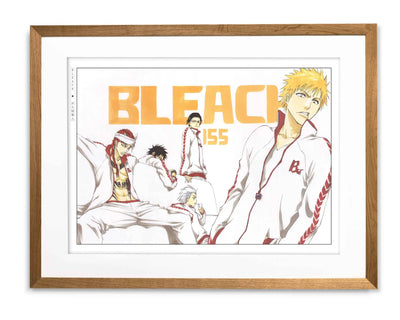
Tite Kubo in Bleach uses silhouette and negative space to give figures a monumental stillness — a figure stripped back to shape and posture, surrounded by emptiness, lands harder than one surrounded by detail. In Neon Genesis Evangelion, directed by Hideaki Anno, long still shots and severe angles make rooms feel tense before anyone has spoken. These are very different works. Both trust the image to carry more than the dialogue. See the Bleach collection.
For more on how anime builds atmosphere through image, see Anime as Art: From Screen to Wall.

Studio Ghibli and the Moving World
Studio Ghibli offers the clearest modern version of this tradition in motion.
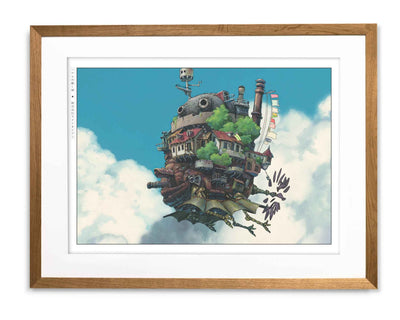
What makes Ghibli so memorable is not only character or story — it is the weight the world itself carries. In Spirited Away, Chihiro standing before the bathhouse feels small against its scale and strangeness. In Princess Mononoke, the forest feels ancient and dangerous before anyone explains why. In Howl’s Moving Castle, sky, weather, and interior detail make the world feel inhabited down to its furthest edge.
These scenes stay with people because the setting is never neutral. It is always doing part of the emotional work.
That is the connection to older Japanese art. Ukiyo-e lets water, weather, and landscape carry the force of the image rather than a face or a gesture. Ghibli works in exactly the same way, but with movement added. A field of light moving across grass. A darkened bathhouse lit against the dark. A line of trees bending in wind. The environment speaks before the character does.
And like ukiyo-e, Ghibli knows how to work at different scales. It can make the world feel immense — the sky too large for the figure standing under it, the ocean too wide for the boat crossing it. But it also knows how much can rest in something small: one change of light in a room, one patch of weather passing, one moment of stillness in a scene that has otherwise been in motion. See the Studio Ghibli collection.

Why This Matters Now
A Hokusai print does not feel random next to anime background art. An Ohara Koson bird print does not feel far from a quiet Ghibli scene. The mediums differ, the centuries differ — yet they share a way of building force through image rather than explanation.
Some pieces calm a room. Others sharpen it. Some arrive at once. Others settle slowly and stay. Either way, they tend to feel composed rather than accidental — as if each element of the frame has been placed with intention.
Ukiyo-e teaches you to hold tension. Manga teaches you to pace it. Anime shows what happens when that tension starts to move.
Once you feel that arc, ukiyo-e stops looking like distant history. It starts looking like the source of something still unfolding.
The Eastern Archivals Archive
Japanese art prints, manga artwork, and anime wall art — printed on archival matte paper.
Shop the Archive